 Posted by
 The legacy of Ibadat in the sacred month of ShehrAllah, especially during Laylat al-Qadr, remains alive through the existence of the Duat al-Mutlaqeen (RA). In every era, the focal point of all acts of worship—particularly in ShehrAllah—is the Ibadat of the Dai of that time. He assumes the role of al-Falak al-Muheet (the surrounding orbit), through whom believers gain the momentum and inspiration to engage in Ibadat.
RasulAllah (SA) established the foundations and doctrines of Ibadat. He not only instructed but also personally exemplified Ibadat at the highest level. Despite this, no follower has ever been able to imitate even a fraction of his Ibadat. Nevertheless, divine command obligates believers to follow in his footsteps, even if complete attainment is beyond human capacity.
Thus, the responsibility of Ibadat does not cease due to inability. Rather, each believer must strive according to his capacity. The most effective way to do so is by following RasulAllah (SA), His lineage, and in times of their seclusion, their نائب (vicegerent). In every era, this vicegerent creates an environment that facilitates and beautifies Ibadat for the believers.
One of the most profound manifestations of this is the composition of مناجاة شريفة (Munajaat Sharifa). Each year, these supplications serve as a divine fountainhead, drawing mankind closer to Allah Ta‘ala. Their unique recitation penetrates deeply into the hearts of the Mumineen, even for those who do not understand the Arabic language.
As a Muhaffiz working in the field of Qur’an memorisation, one aspect that stood out prominently in this year’s Munajaat is the healing power of the Qur’an—for both the soul and the body. As Syedan Aali Qadr Mufaddal Saifuddin TUS states: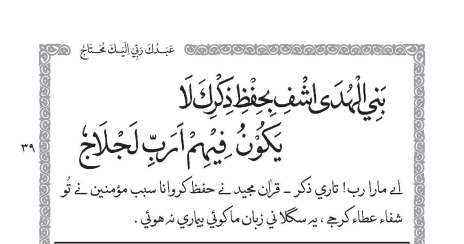
While the Munajaat Sharifah encompasses numerous themes, it also addresses contemporary human struggles in eloquent and profound expressions. Among its supplications is a prayer for those who seek a cure through the Qur’an. As emphasised by Aqa Maula (TUS), the Qur’an is a remedy for every ailment—whether minor or severe, physical or spiritual.
In particular, this year’s Munajaat draws attention to ailments related to speech and the tongue. Although such disorders may appear physical, they often have deeper psychological and neurological roots.
From a medical perspective, speech disorders include:
- Dysarthria (slurred speech)
- Apraxia (difficulty in speech planning)
- Fluency disorders (stuttering, cluttering)
- Voice disorders (hoarseness, dysphonia) and many more.
These conditions may arise from neurological damage, muscular weakness, or structural issues. However, they are often closely linked to mental and emotional states.
Thus, it can be understood that the Qur’an, being a cure for the heart and mind, ultimately addresses many physical manifestations of illness as well.
In today’s world, even capable students and professionals suffer from low self-esteem and lack of confidence. The Qur’an offers a powerful remedy for these hidden struggles. A person facing such challenges can turn to the Qur’an—not only for spiritual reward, but for deep internal healing.
Real-Life Testimony
I would like to share a real-life example.
M Taher Bhai Aziz Bhai from Dahod suffered from a stammering problem in his early years. Due to this, he developed fear and hesitation in social interactions. However, he was blessed with admission to Aljamea-tus-Saifiyah, Surat.
Initially, he struggled greatly with memorisation and confidence. But as he persisted in memorising the Qur’an, a transformation gradually occurred. With time, his fluency improved, his confidence increased, and he eventually completed the memorisation of the entire Qur’an.
This example clearly demonstrates that even conditions perceived as difficult or incurable can find remedy through the blessings of the Qur’an.
I would suggest that if a trader experiences a lack of confidence while presenting his product and convincing customers, he should turn towards the memorisation of the Qur’an. Such hesitation is often not merely a matter of speech but rooted in deeper mental and emotional barriers.
Similarly, if a professional struggles to respond confidently during a job interview, engaging with the Qur’an—particularly through memorisation—can help develop clarity of thought, composure, and inner confidence.
These examples illustrate that many challenges we perceive as external or skill-based are, in reality, connected to the internal state of the mind and heart. The Qur’an, being a source of spiritual strength and mental discipline, plays a significant role in addressing these inner obstacles.
The scope of such benefits is vast, and these are only a few examples; many more can be observed and experienced in different walks of life.
May Allah Taala grant a healthy a prosperos long life until the day of Qiyamat to our beloved Aqa Maula Syedna Aali Qadr Mufaddal Saifuddin TUS for guiding us towards a path with divine guidance. Ameen.